RAR Writes up to date with the Latest and Greatest fine Art, Design, Products and Fashion from all over the world

Showing posts with label Andrew_Probert. Show all posts
Friday, March 14, 2014

Watch Andrew Probert's Glorious "Early Science Fiction Contributions" Video


Check out this video of early concept art by Andrew Probert!

Every Friday I try and feature artwork from a classic of science fiction cinema or television. This week's "Flashback Friday" post is on Battlestar Galactica, Star Trek: The Motion Picture and Star Trek: The Next Generation.

Andrew "Andy" Probert is a legend in the industry of conceptual design for designing iconic villains and sleek star ships. Recently he shared a fascinating video profiling his early television work and it is wonderful.

Andrew Probert is a professional concept artist who's worked on classic science fiction projects like Back to the Future (1985), Star Trek: The Next Generation and Battlestar Galactica (1978).

.

See more of Andrew Probert's marvelous portfolio at http://www.probertdesigns.com/

Click on the links if you want to see more of Andrew Probert's work or Battlestar Galactica, Star Trek: The Motion Picture and Star Trek: The Next Generation on my blog.

What do you think of the concept art video? 

Friday, October 11, 2013

Blind Cylon BATTLESTAR GALACTICA Concept Art by Andrew Probert

Battlestar Galactica Cylon concept art by Andrew Probert.

Check out Battlestar Galacticaconcept art by Andrew Probert!

Every Friday I feature artwork from a classic of science fiction cinema and television. This week's "Flashback Friday" post is on  Battlestar Galactica (1978).

Back in the 1970s the premier science fiction show was Battlestar Galactica. Even though the show only lasted one season, it's legacy has lived on for decades. The villains, the murderous robot Cylons, have become an enduring part of American culture.

I found an old magazine article from 1980 that interviewed Andrew Probert, one of the main concept designers on the show, about the design of the Cylons.

Probert is a professional concept and storyboard artist who's worked on classics of movie and television like Back to the Future (1985), Star Trek: The Next Generation and Indiana Jones and the Temple of Doom (1984).

Check out the rest of the images after the jump (click to enlarge).


Andrew Probert designing Battlestar Galacticaconcept art
Here's the text of "Secrets of the Cylons" (published in Fangoria #5, 1980) in it's entirety:

"Andy Probert was a student of industrial design in Southern California when he first met Ralph McQuarrie. In the course of interviewing the Star Wars designer for an article for his school newspaper. Probert showed McQuarrie some of his own student work; not long after, McQuarrie hired Probert as part of the Battlestar Galactica design team. Currently. Probert is becoming one of the top names in film design, thanks to his vital contributions to the spacecraft designs in Star Trek - The Motion Picture (see STARLOG #32, now on sale, for details on Probert's Trek designs).

"One of Probert's chief contributions to Galactica was his development of the show's durable villains: the Cylon Centurians. He offers some surprising insights into the evolution of that now-familiar design:

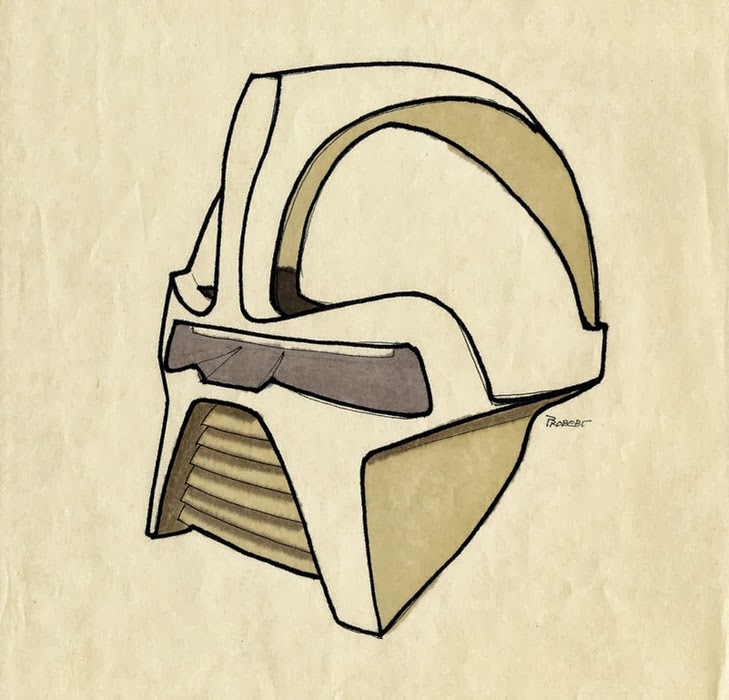
"'Joe Johnston and I developed the Cylon helmets.' says Probert. 'we had one requirement given to us: the helmets had to have a built-in scanner, because at that time the CyIons were to be living creatures who were blind. Our first sketches were based on Ralph McQuarrie's preproduction art, in which he showed the helmets as smooth and dome-like, with a scanner slit about half way down.
Original Cylon Alien Sculpt


"'While we were working on the helmets, there was a rubber head of an earlier version of the Imperious Leader. His 'mouth' area had a stepped-down appendage. I saw in it a similarity to the cockpits of Cylon fighters, which had already been designed. I liked the idea of repeating that pattern.

"'Eventually, Glen Larson (the series' executive producer) said he wanted the helmets to take on the look of a human skull: so our designs began to take that direction. I wanted to make a skull-like helmet and integrate that feeling throughout. We had heavy ridges around the eyes which worked into heavy cheekbones which worked into an open, snarling mouth. Instead of vertical teeth, I went to the horizontal down-stepping pattern in previous designs. The shapes on either side of the cheekbones began to suggest the helmet of Greek or Roman warriors: so I added the top notch.

"'We understood the Colonial Warriors were to have an Egyptian motif: and Joe and I were suddenly taken with the idea of making the Cylon Centurians look more like ancient warriors. He went in the direction of Genghis Kahn, with heavy chain mail, and I went toward Greek or Roman warriors.

"'We were then asked to present designs for the entire Cylon uniform. We were told they should have a high-waisted look.

"'I produced a design which illustrated armor above the waist and semi-soft clothing below. I added boots which had pouches for tools and supplies. To complete the feeling of a Greek warrior. I added a waist skirt and a sword.


"'The one thing we were consciously trying to stay away from was any visual identification with the Stormtroopers of Star Wars. One thing that kept irritating me when I watched Star Wars was that the Stormtroopers had hand-held weapons which they were prone to drop. In hopes of eradicating the problem while further decreasing any comparison with the Stormtroopers, I designed a weapon for the CyIons that was built into their wristbands. It could be fired by nerve impulse or muscular contraction. Later, when the movie came out, I discovered that they had gone back to hand-held weapons - alas.


"'In one illustration. I made the armor of reflective material, to differentiate the armor from the soft clothing. Originally I hoped for a dark copper armor with olive green fabric. But in another of my illustrations the armor was silver; and that happened to be the one Glen Larson liked

"'Incidentally. I never worked on them as robots or androids. They were living creatures all the way through the making of the pilot movie. As I understand it, they were changed into evil machines for television because there's a limit to how many people you can kill in an episode, but you can bump off as many machines as you want to.'

"It was shortly after speaking to Probert that FANGORIA learned of the one-episode revival of Battlestar Galactica (tentatively scheduled for January airing at our press time).

"According to Glen Larson, who scripted the final chapter, the program will concern the events that follow the Galocbca's arrival in Earth orbit. Whether the program also includes the final solution to the CyIon problem is more than Larson is willing to reveal. But the metallic menace will continue —Cylons continue to be one of the most popular features of the Universal Studios tour; they will be supporting villains in The Nude Bomb, a Universal feature film based on the old Get Smart television series: and MCA Television (Universal's syndicated TV branch) is currently preparing a package of 12 two-hour Galactica movies for American TV syndication. These telefilms, compiled from the broadcast series, will also contain some footage never before seen! For millions of BG fans (and we don't mean the Brothers Gibb) a prospect worth waiting for!" - David Houston (FANGORIA #5, 1980)

By the way, the Galatica movies were eventually turned into a television series called Galactica 1980. Unfortunately for BG fans, the show was canceled after ten episodes. But, years later, the show was rebooted by Ronald D. Moore and David Eick in 2003 for a min-series. That mini-series spawned an award-winning television series in 2004 that ran for four years.

caption: Probert's initial designs for a flesh-and-blood Cylon. inspired by warriors of the classic ages. Compare these with the metallic malignants pictured at the top of this page.

See more of Andrew Probert's work on film and television at http://www.probertdesigns.com.

Click on the links if you want to see more of Andrew Probert's work and Battlestar Galacticaon my blog.

Images via galactica.tv

What do you think of the concept art? If you've seen Battlestar Galactica what did you think?

Official Battlestar GalacticaSummary
In the deepest reaches of space, the fight to save all human life from extinction has begun in this science fiction adventure that launched the Battlestar Galactica phenomenon! Hopeful for lasting peace following centuries of intense warfare, the Twelve Colonies gather to sign a treaty with their dreaded enemies, The Cylons. But after an act of treachery on the eve of the ceremony, the Cylons launch a devastating surprise attack, destroying the Colonies' home planets and most of their military strength. A lone flagship battlestar, the Galactica, remains to aid the surviving colonists on their epic journey for a new home to a far-off legendary planet--Earth. They must survive the pursuing Cylons in a series of epic battles that will determine the fate of the human race in this non-stop action-packed classic filled with cutting-edge special effects by John Dykstra ("Star Wars," "Spider-Man").
Created by  Glen A. Larson
Starring: Richard Hatch, Dirk Benedict, Lorne Greene, John Colicos, Maren Jensen, Noah Hathaway, Jane Seymour, Herb Jefferson, Jr., Jonathan Harris, Tony Swartz, Laurette Spang, Terry Carter, Ed Begley, Jr., Rick Springfield, Anne Lockhart, David Greenan, Sarah Rush
Air date: September 17, 1978
© Copyright 1978 Glen A. Larson Productions,  MCA/Universal. All rights reserved

Wednesday, October 9, 2013

FAQ: What is Keyframe Concept Art?

"The Hulk" Avengers (2011) keyframe by Charlie Wen TM & © 2011 Marvel. All Rights Reserved Source
If you're here for the Norse Gods Blogfest head to the bottom of the post. :)

What is key frame concept art? You may read the term "Keyframe" being used to describe concept art and wonder what it means.

Of course, using the term "concept art" to define keyframes isn't wrong, but I would define it as a illustration of a key scene from the movie script and it's not the same as a concept design for a prop, set or costume.

To find out if I was close, I asked professional concept and storyboard artists what keyframe concept art is and collected their answers. Learn from the industry professionals what exactly keyframe concept art is.

Learn more after the jump.


The Definition
"A Key Frame is the mid point between concept art and storyboard art in my mind." - Rob McCallum (http://mccallumart.com)

"A key frame is a rendering depicting a particular moment in the script or story." - Tim Flattery (http://timflattery.com)

"It refers to a key 'scene' when referring to set designs or moments in the script." - Andrew Probert (http://probertdesigns.com)

"A KEY FRAME is a concept illustration of either a 'Money Shot' ( where a big slice of the budget is spent)....or a 'Master Shot' that conveys and captures the feel or the style/look of that scene of the movie." - Chris Buchinsky (http://captzeppelin.wix.com/chris-buchinsky-)

"'Key Frame' is usually referring to a a key pose while animating a character, there are multiple 'key frames' while animating a character walking or running etc. In films we will usually have to illustrate scenes from a story/script which are sometimes referred to as 'key scene illustrations' I guess I have also seen the term 'key frame' be used for this as well? Which means just that: 'illustrating a key(main) scene from the story'. It just means you are showing a director/producer what the film could look like, so maybe you design all the costumes and weapons early on then you put them all together to show what they look like in action at that particular point in the story. Or the opposite, the story is illustrated first but the designs aren't figured out and they are designed in more detail later, just a part of the process." - Ben Mauro (http://www.artofben.com)

"A key frame is a piece of art that ends up as the basis for the final shot. or, at least in pre production, it's a shot that the director is happy with as a 'look' for the show and therefore gets termed a key frame." - Mark "Jock" Simpson (http://www.4twenty.co.uk)

"The difference between Key Frame and a set concept or a costume concept is a key frame is usually create from the highest point of a scene from the script." - Henry Fong (http://www.henryfong.ca)

"A key frame is an actual moment in the story, and may well have already drawn by the storyboard artist.  However, because it is an important moment or 'frame' from the story, it is often developed further than the standard storyboard 'frame' into a full blown concept illustration." - Nathan Schroeder (http://www.nathanschroeder.net/)

"A key frame is an important moment in the story, sometimes a large, detailed storyboard frame, that is more about action or "shot design" than about element, set, or costume design. Sometimes it's about a VFX moment. Either a concept artist or a storyboard artist may be asked to do it, depending on the dynamics of the crew and the relationship with the director." - Peter Rubin (http://ironroosterstudios.com)


"Keyframe concept [art] is basically an illustration that shows some kind of story or action. It's used to show the director what a final frame might look like. Typically is less about design and more about showing action or story." - Emmanuel Shiu (www.eshiu.com)

"From my perspective, a Key Frame illustration is meant to capture a specific moment in a film — to show the viewer exactly what a actual frame from a movie will look like.  This is different from a concept design drawing of painting, as these are primarily concerned with the design of a specific element (or environment) featured in a film.  Put a slightly different way, the Key Frame services the film in totality — where as a concept design provides insight into the design of an element of the film." - TyRuben Ellingson (http://www.alieninsect.com/)

The Design
"The artist must capture the mood and keep it poetic to the writer's work as well as what is in 'The Mind`s Eye' of the Production Designer and the Director's vision." - Chris Buchinsky (http://captzeppelin.wix.com/chris-buchinsky-)

"Key frames are more for mood and the overall feeling of the picture than they are for any solo conceptual idea, i.e. Props, costumes, production design, costume. They are key scenes from the movie illustrated keeping all of the aforementioned in mind. They are different from storyboards in that boards usually depict a scene through sequential imagery whereas a key frame would depict that same scene with one descriptive illustration." - Phillip Boutte Jr. (http://phillipbouttejr.carbonmade.com)

"Typically it will show the 'key' moment of the scene. The point of the scene that expresses the shot, the lighting, the mood and action. Everything you need to know distilled into one image." - Rob McCallum (http://mccallumart.com)

"The goal of creating a Key Frame is to express the mood and camera composition(angle) to bring the scene to it maximum level of drama. It usually doesn't focus so much on the design aspect of set or costume design.  The design is usually provided by fellow concept artist and depends on what stage of production you are at." - Henry Fong (http://www.henryfong.ca)

"The purpose of any illustration is to show what a set, or vehicle, or character may look like, but presented in a way that allows the viewer to understand what the design is, not necessarily how it will appear in the film.  We may illustrate a large set like a control room, or grand palace in a very wide angle, so that a director can see the whole set in in its entirety; but with the understanding that we will probably never see it that wide in the film.  We may illustrate a character in a pose that never happens in the story, but which allows the viewer to see the full costume.  The same goes for vehicles and props." - Nathan Schroeder (http://www.nathanschroeder.net/)

Avengers (2013) Keyframe by Andy Park © 2011 MVLFFLLC. TM & © 2011 Marvel. All Rights Reserved
My favorite piece of Thor concept art by Andy Park for the "Norse Gods Blogfest."

About the Blogfest
This post is part of Siv Maria Ottem and Alex J. Cavanaugh's "Norse gods" blogfest. Anyone who buys her book Secrets of the Ash Tree during this blogfest can email her and she'll send them an autographed print of the Freya illustration made by her daughter Maria Bech. This illustration is not available anywhere else and is not included in the book.  She'll also be giving away a signed copy of her book to who-ever actively parties the most today. So, if you want to join in, spread the word, use her banner, visit as many blogs as you can, and write a great post! She's giving away special points if you visit her new web page http://sivmariaottem.com/and like her Facebook Author page!

Secrets of the Ash Tree is available at most online retailers including Amazon and Barnes and Noble.
Official Description: 'Secrets of the Ash Tree' is the story about Liv, a young woman who discovers her true nature through the unraveling of hidden secrets. Her adventures begin when she digs up a chest that was buried by her father under the old ash tree in her garden. What she finds inside the chest changes her life forever. Liv discovers one secret after another and is thrown into a world full of dangerous and strange creatures, mighty Norse warriors and perils beyond her belief. What started out as a fairy tale in her father's journal was to become her legacy, a guide line to survival, and a map to the world she was about to enter. Each day, each mystery, each encounter will ultimately reveal her true destiny and behind the edge of a sword awaits a young god who is willing to share that destiny with her.

What do you think a key frame is? Do you prefer them to other types of concept art? What's the best key frame concept art you've seen?

Tuesday, May 7, 2013

11 Concept Art Designs That Changed Movie History Forever


Movie history is full of brilliant images and inspired designs. But some designs have left their mark on films when the last flicker of light plays in the theater.

Check after the jump to see the designs that inspired generations of filmmakers.


11. Discovery One by Harry Lange
2001: A Space Odyssey

Discovery One concept art by Harry Lange via Digititles

Stanley Kubrick and Arthur C. Clark set out to make the most realistic science fiction movies ever made. The common stereotype of anti-gravity generators were thrown out in favor of the scientifically accurate centrifuge that created a type of gravity. Even today it's ground breaking on a science-fiction film to be so scientific.

10. Predator Alien by Stan Winston
Predator (1987)
Predator concept design by Stan Winston

The original design for the Predator (then called Hunter) was a bug like alien. Make up designer Stan Winston created the most unique looking alien ever. It was James Cameron that suggested the mandibles.

9. Star Trek Enterprise by Matt Jefferies
Star Trek (1966)


Star Trek Enterprise by Matt Jeffries source
The design of the starship USS Enterprise (NCC-1701) broke all the rules. Roddenberry wanted to get away from the cigar shaped designs from 1950s science-fiction and Star Trek art director Matt Jefferies was the man to do it. With Jeffries' experience in aviation, he was able to design a ship that was unique, familiar and majestic. From the unique look of the engines, to it's unconventional design, it rewrote the book on spaceship design and ushered in a whole new world.

8. Machine Man (Maschinenmensch) by Walter Schulze-Mittendorff
Metropolis (1927)

Metropolis Machine Man by Walter Schulze-Mittendorff source

The robot woman in the German film Metropolis has influenced designers for decades. Star Wars' C-3PO was heavily influenced by her design.


7. Delorean Time Machine by Ron Cobb and Andrew Probert
Back to the Future (1985)
Delorean designs by Ron Cobb source
Designed by Ron Cobb, and finished by Andrew Probert, the Delorean is the most unique time machine ever designed. The car company went bankrupt after a

6. Planet of the Apes Statue of Liberty by Don Peters
Planet of the Apes (1968)

The ending of the original 1963 novel, Planet of the Apes (La Planète des Singes) by Pierre Boulle,had a distant world taken over by apes. It was only when Don Peters drew the image of the State of Liberty buried in the sand that the greatest twist ending of all time was created. Several people, including screen-writer Rod Serling, took responsibility for the idea. Peters claims that it was his idea alone, from preliminary sketches for Arthur P. Jacobs when the film was in development at Warner Bros.


5. Robby the Robot by Robert Kinoshita.
Forbidden Planet (1955)

The initial design was sketched by Arnold "Buddy" Gillespie, refined by production illustrator Mentor Huebner, and then turned into reality under the direction of mechanical designer Robert Kinoshita. Multiple designs were created for the concept of Robby the Robot in the 1955 film Forbidden Planet, but Kinoshita did the final design that created the most iconic and popular robot ever.


4. "Spinner" Police Cars by Syd Mead
Blade Runner (1982)
Blade Runner car designs by Syd Mead source
The entire look of Blade Runner has set the standard for dystopian science-fiction. It's gritty style and futuristic designs has influenced science fiction films, anime, video games, and television programs like Battlestar Galactica. Syd Mead's car designs, known as "Spinners," that have set the standard for flying cars.

3. Xenomorph by H. R. Giger
Alien (1979)
H.R. Giger Alien source
The Alien design is credited to Swiss surrealist and artist H. R. Giger. It started in a lithograph called "Necronom IV", but was refined for the film Alien. The Alien design is the most effective biomechanical design ever. Not only is the design imitated in other sci-fi movies, but video games like Metroid and Contra have used it as well.


2. Darth Vader by Ralph Mc Quarrie
Star Wars (1977)
 
Early Darth Vader sketch by Ralph McQuarrie source

The most famous villain ever is known for his skull-like mask. While director George Lucas created the character, it was Ralph McQuarrie that came up with the idea of Vader wearing a gas mask to travel onto the ship. McQuarrie's done some amazing designs, but this one stand above them all.


1. Terminator by James Cameron
Terminator (1984)
Director James Cameron is also an accomplished artist. His drawing of the murderous Terminator robot with half his face missing has become the symbol of terror for decades. Every Terminator film has used it.
Friday, September 7, 2012

What is An NDA or Non-Disclosure Agreement?

Alternate ending for Iron Man 2 by Ryan Meinderding
Whiplash says, "Don't release that concept art!" One thing that has a huge impact on my blog is the NDA (Non-Disclosure Agreement) that studios use. Since I'm not in the industry, I'm an outsider looking in.

In some cases I find artists that have worked on a film years ago and there's no problem sharing the art.

Other times I know a movie is coming up and contact the artists. I know they can't reveal any details without approval from the show or until after it has been released. But I can at least line up the illustrations and interviews for the day the show opens.

For those outside Hollywood the question comes up: What is that thing anyway?

I contacted five major industry artists to find out what an NDA is and how it affects their work. They all said NDAs are a necessary part of the industry and it doesn't impact them unless they can't show their work.

Dawn Brown is a set designer and concept artist in the film industry for almost 20 years. She's worked on huge films like Star Trek (2009), Alice in Wonderland (2010) and the upcoming The Hunger Games: Catching Fire (2013).

Craig Shoji is a concept artist who's worked on blockbusters like Avatar (2009), Thor (2011) and Men In Black 3 (2012).

Nathan Schroeder is a conceptual artist in the movie industry that has a huge comic book pedigree with films like The Avengers (2012), X-Men (2000) and Star Trek (2009).

Rob McCallum has been a storyboard artist for almost 20 years in movies and television. You've seen his work on Falling Skies, 16 Blocks (2006) and Resident Evil: Apocalypse (2004).

Andrew Probert is the legendary concept artist who helped create the DeLorean in Back to the Future (1985), The Enterprise in Star Trek: The Next Generation and more. He has over 34 yeqars of experience in the industry.

What is an NDA?

Dawn Brown
"A Non-Disclosure Agreement is basically a confidentiality agreement between the employer and the employee. It requires that the employee not share any information they receive while working for the employer. In reference to concept artists working in the film industry, every studio asks us to sign one at the start of every single show. We must promise not to publicly discuss or share any artwork, designs, script info, etc. The term of the agreement typically ends when the feature film is theatrically released."

Craig Shoji
"I'd say it's a written, contractual agreement between (at least) two parties that infers that there will be 'confidential' material and information shared, and that neither party should 'disclose' any of that information to any entity outside of that contract.

"In film it's usually between an entity that's labeled the 'Producer' and one that's the 'Artist.'

"Although there aren't normally expiration dates on them, the producer usually determines when information can be shared to the public by first releasing it. Either through a public trailer, marketing material, the release of the movie, or a 'making of' book. I believe they still reserve the right to ask an artist to not publicly showcase any work created under that contract for whatever reason."

Nathan Schroeder
"An NDA is a non-disclosure agreement that we all sign whenever we start a new show.  It says we cannot reveal anything about the project we are working on (presumably until the film is released.) "

Rob McCallum
"I'd say an NDA is legal document you sign stopping you from telling anyone outside of the production- in this case- anything about the project so it's kept a secret. They are common on all jobs these days. You can't show work to anyone, you can't tell anyone details if it hasn't officially been released."

Andrew Probert
"An NDA is an agreement signed by a person who's hired to work on a project of which the producer does not want it's contents revealed to anyone not working on that project."

How does it affect your work?

Dawn Brown
"Personally, I think its perfectly reasonable for the studios to ask the crew not to spill the beans on their projects. As far as how it affects my work, the hard part is the giant lag time between when we wrap a show and it's theatrical release.

"For example, I finished Oz: The Great and Powerful last summer 2011, but I can't show anything until spring 2013. By the time I can add it to my portfolio, the artwork will be almost 2 years out of date!

"But that's the nature of the beast and most people understand this and play by the rules."

Nathan Schroeder
"It only affects us in that we can't post work on our website until a show comes out.  It can be a problem if a show goes down and is never released."

Andrew Probert
"The only way it affects my work is in not being able to use the materials I've provided (as works for hire) as work examples, to be shown to anyone outside of the project until (typically) that project has been released to the public."

Craig Shoji
"As far as how it affects me, it's usually a little bit of a bummer that I can't 'show off' the work that I create until a couple of years after they've been completed and the film is released.

"But internally, usually all the people who are in a position to hire me (producers, production designers) on the next film have come across that work in the pipeline, or are already familiar with my work and working with me. The producers and production designers that come across my work have most likely already signed an NDA with the studio or they're part of a company that has most likely signed off on the NDA (post production house, working on a sequel to the film, etc).

"So it's usually not a problem for establishing 'credibility' for finding work. And it's a necessary part of working on a creative property so I wouldn't hesitate to sign one that I've read through and OK'd."

See more of the artist's portfolios at their sites
Dawn Brown dawnbrown.net/
Rob McCallum mccallumart.com
Andrew Probert probertdesigns.com
Nathan Schroeder nathanschroeder.net
Craig Shoji pensketch.com

Did you learn anything about the industry? What do you think about NDAs?
Tuesday, March 13, 2012

Exclusive: Andrew Probert Talks About Designing 'Star Trek,' 'Battlestar Galactica' And His 'Digital' Art

Normally, I only post on Mondays, Wednesdays and Fridays, but this is a very special post.
Andrew Probert has been a designer for over twenty years, but his most famous work was on Star Trek: The Next Generation. A legend in the concept design world, Andrew G. Probert has an artistic career working on some of science-fiction's greatest Hollywood productions.

His Hollywood career began as a designer for Glen Larson's Battlestar: Galactica. He was a major contributor on the planned Star Trek television sequel Star Trek: Phase II and the film Star Trek: The Motion Picture as concept designer/illustrator.

Probert's career has spanned numerous influential television shows like Airwolf and Street Hawk and films like Back to the Future and *batteries not included (1987). He's also the creator of the iTunes app "Concept 101: The Worlds of Andrew Probert."

He was kind enough to answer a few questions for my blog. He talks about his inspiration for Battlestar Galactica, how his being a Trekker influenced his designs of the Enterprise and his approach to "digital" drawing.

Q: When did you know you wanted to be a production illustrator?
While attending Art Center College of Design, as an I.D. [Industrial Design] student, a bunch of us heard there were some amazing sketches down at Long Beach State college, I think it was, and we went down there to check 'em out.  They were pre-production sketches produced mostly by Joe Johnston for Star Wars (the first film).  That was when I wanted to do that, right then & there.

Q: Do you usually start with a lot of sketches before you draw, or do you just start and see what happens?
I always start with as much information I can get, regarding what it is I'm asked to Illustrate or Design.  With that in my head, I usually get into my 'form-follows-function' mode and start sketching the item based on it's practical usage, operating mode, entry/exit methods, etc... everything an Industrial Designer does when looking for a Design solution.

Q: What was your most surprising inspiration for the Cylons in Battlestar Galactica?

My Cylon sketches started with Ralph McQuarrie's (RIP) preproduction paintings & sketches but I moved away from those when I hit up the idea of the Cylons being one group of many "Ancient Astronauts" that are supposed to have visited Earth during Mankind's early years.
I then came upon the idea that maybe the Cylon's helmet & armor influenced the look of Greek armor & helmets in particular so I developed that idea and it worked.

Q: You've done a lot of concept art, but you've also done storyboarding. Do you have a preference between them?
Even though I have a strong understanding of the cinematic story-telling process and the dos & don'ts of where to place the camera, maintain screen direction & all, I feel I'm more valuable in providing designs of hardware, props, and sets because of my Industrial Design training.  I'm able to surmise how these 'products' might be manufactured and how, in my opinion, they would best be formed to satisfy the duties for which they'd be constructed.

Q: What went through your mind when you were redesigning the USS Enterprise for Star Trek: The Next Generation?
There was a lot of angst among the Star Trek fans about how we were going to "replace" their beloved original version of Star Trek.  Being a Trekker myself, I could understand their concerns which I was dedicated to address the best ways I could.

My first task was to design the bridge and I took as many details as I could, from Kirk's original bridge, and incorporated them into what Gene has asked me to come up with.  When Herman Zimmerman came on board as Production Designer, he asked me to consult on the remaining sets in order to provide continuity with the look of the new bridge as well as provide as much familiarity as I could get into those other spaces, the transporter room layout & details, for instance, as possible.

At the same time, I moved into providing designs for the ship's exterior which was accepted & approved by the Producers rather quickly.  As for design thinking, I wanted the ship to look like a very advanced version of Kirk's ship including the hull's general coloring while grabbing bits & pieces of newer Starships along the way.

Although painted kind of a pearl gray, the original miniature picked up a lot of blue from the SFX blue-screen background, making it look blue-ish on television so I called out colors to emulate that coloring.  Then for some unknown reason, however, the FX team optically neutralized the coloring down to grey.

Q: While working on Back to the Future, how much of Ron Cobb's work remained in the final design of the DeLorean?
Probably 80% is still Ron's. I provided all the remaining detailing and a couple of small changes on the car.

Q: What do you think is your greatest achievement so far?
My four beautiful children... all with families of their own now.

Q: Do you prefer digital or traditional art tools?

I'm still clumsy when "painting" on a computer.  Therefore, the only 'digital' painting I do is using the digits found at the ends of my arms.

Q: You recently acted in the fan film Star Trek New Voyages: Phase II as Commodore Probert. How did you get involved and what was it like working on it?
Image: Andrew Probert (left) Gil Gerard (center) with James Cawley (right)
I met James Cawley at a convention and we hit upon the idea of my doing a cameo in his next show.  Well, I got a script and (fighting my notoriously bad retention skills) memorized my few lines.

When I showed up on set, however, several of my lines were handed to another actor, which really threw me to the point of not remembering anything.

I then ended up making kind of mess of my scenes and can only hope now that they edit me into some perceived cinematic glory.

Q: Are you still producing art personally or professionally? If so where can we see it next?

I do offer Art Prints on my website but along with that, I have, for a while now, been creating hand-painted Renderings for the calendar:  'Star Trek - Ships of the Line' every year or so.  That's probably the most consistent showplace for my new pieces.

I am, on rare occasions, commissioned to provide a painting for someone looking for original Art.  Last year I was invited to speak to the I.D. department of the University of Cincinnati and, of course, I'm still invited to speak at conventions, every so often, but since I haven't been involved in any current productions for awhile, my talks are pretty much retrospectives.  Having said that, I'm developing kind of a Hardware Design Workshop to supplement those slideshows. 

I just recently completed a series of Concept Designs for 'The Blue Man Group', working with another Artist/Designer Eric Wilkerson, creating new,... hmm, let's say 'props' for a show that is to debut in Las Vegas later this year or maybe in 2013.

And, lastly, I've just started creating a new website which I'm hoping will encourage me to post more materials and maybe even more art prints in the bargain.

Q: Thank you so much for your time.
You're very welcome.

You can see more of Andrew Probert's portfolio and work at http://www.probertdesigns.com.

Check out more of my interviews with amazing artists on my List of Interviews page.

What do you think of Andrew Probert's work?
Related Posts 
Wednesday, February 15, 2012

Drive In And See Andrew Probert's 'Streethawk' Motorcycle Designs

The hi-tech motorcycle for the 1985 show Streethawk was designed by veteran artist Andrew Probert (Star Trek: The Next Generation, Back to the Future, Battlestar Galactica) and here are some illustrations from his site.

Streethawk was one of my favorite shows as a kid. Not because it was any good, but I loved the motorcycle. While I was doing research for a post called Ten 'Knight Rider' Knock-Offs That Failed Miserably, I discovered Andrew Probert did the designs!

I had to see them and, thankfully, he posted a bunch on his site. Here are my favorites along with his commentary of each design stage.
Design Development
...of a new type of motorcycle that would have the capability of traversing rough terrain as well as reaching a speed of 300 miles per hour.

Research

The first thing any designer does is research the item to be designed. I soon suggested that this multi-role machine would need two real-world bikes to be the muscle underneath. I further suggested a Honda shaft-driven street bike and one of their dirt bikes.

The  Bike was constructed by Gene Winfield's 'Rod and Custom Construction, Inc.'and when they got a dirt bike, I asked it I could take some shots of it and a rider so I might have something, in my design process, from which to sketch.  That's Gene, himself, holding the bike and my rider-model.

First Concept

I wanted to give this bike a look to suggest that it could (somehow) generate enough power to propel it's rider to 300 mph, as required in the show's premise.  This is the earliest sketch, in the series, that I could find..apparently not having documented my usual initial scribbles..

Second  Concept

This is mostly a refinement of that first direction.  Right away, I was concerned about incorporating streamlined wheels, and a back section of the seat that would rise up, at high speeds, in order to support the rider.  I also designed the back wheel support in a way that it might cover the (proposed) two different drive systems.  I imagined that the bike would morph between the two extremes,. high suspension/handle bars and chain for dirt, morphing down to low suspension/handle bars and shaft for high speed street work.


Weapon-1

The bike's main 'beam' weapon was required for a variety of uses & missions, so I came up with the idea that it could pop out and then swivel into whatever position or angle that was needed.


Final Design

The producers unexpectedly fell in LOVE with a set of wheels they'd seen in some magazine and just had to have them on Streethawk.  I explained that it relegated the 'super-drive' system to a standard chain drive and they didn't have a problem with that.  Subsequently, this next & final design included their special wheel & brake system and was approved.  From that point a 'line' version of the drawing was blown up to full size and used to construct the body of the show vehicle.


Here's the opening which gives you some views of the cycle in action.


Check out the rest of Probert's STREETHAWK_Designs including the dashboard and exhaust system at his site ProbertDesigns.com

PHOTOS ON THIS PAGE: COPYRIGHT © UNIVERSAL STUDIOS, ANDREW PROBERT
Wednesday, January 25, 2012

Great Scott! Storyboards of Marty And Doc's First DeLorean Test From 'Back to the Future'!

One of the most pivotal scenes in Back to the Future (1985) was the first test of the DeLorean using Doc Brown's (Christopher Lloyd) pet dog Einstein. Andrew Probert () did storyboards for the film and posted the scene on his site.

Directed by Robert Zemeckis, the scene has some great visuals, from the license plate spinning in the street to Marty McFly's (Michael J. Fox) hair being blown back by the re-entry. Plus, there's a nice description of what the script calls the "Time-Slice."

I love Doc Brown's hair in these images. I don't know if it was before or after he was cast, but it's great. Probert describes the storyboards this way.
This is the sequence where Doc Brown runs his final test on the DeLorian [sic] Time Machine.


Amazingly cool stuff. Here's the original scene for a comparison.

Feast on these and other cool storyboards and concept art at Andrew Probert's site http://probertdesigns.com/.